Tuesday, 26 February 2013

The real housewife of Downton Abbey

There is endless fascination for the real 'Downton Abbey', Highclere Castle, and the family who lives there.  PBS showed an one hour documentary hosted by the Lord and Lady Carnarvon on the history of their famous home.  Lady Carnarvon has written on the history of the Castle and its former inhabitants, including Lady Almina and the Real Downton Abbey, a recounting of the 5th Earl’s enormously wealthy and controversial wife which I have just read and enjoyed.

Here is an older article on Highclere Castle and how the family copes while Downtown Abbey is filmed.

       Shari Kulha, National Post | May 25, 2012 10| Last Updated: May 28, 2012 4

The staff of Highclere Castle with Lady C, her husband, son and dogs at centre. The Carnarvons move out of the big house when 'Downton' is filming to another house on the property with rabbits and a trampoline.
 
Courtesy Highclere CastleThe staff of Highclere Castle with Lady C, her husband, son and
 dogs at centre. The Carnarvons move out of the big house when 'Downton' is filming
to another house on the property with rabbits and a trampoline.
  • NEWBURY, ENGLAND —  It’s comforting to know that even the aristocracy has to deal with leaky skylights and failed workmanship.
“I paid for it to be fixed,” Lady Carnarvon says with a roll of her eyes towards a phantom skylight. We can’t see it, because she and I are tucked away in the Morning Room, probably hundreds or, given the size of her home, possibly even thousands of feet away.
We chat about the money pit any house can be.
“It pisses me off,” she says quite forthrightly, peering over her cappuccino with a glint in her bright blue eyes. “And now I have to call them again. It’s not like I don’t have other things to do with my days.”
Indeed, the warm and ebulient chatelaine of the 300-room Highclere Castle has a full calendar. Her home — that is, she quicky points out, her husband’s family home, for the past 333 years — is the star of the TV drama Downton Abbey. Close friend and series creator Julian Fellowes spent many weekends over the years at Highclere, no doubt hatching plots between tea and tipple.
Filming the “upstairs” scenes happens between February and June, during which time some 100 cast and crew mill about Highclere’s hallways and hillsides. Right now, they’re about halfway to wrapping the third season. But they’re nearing deadline, as July and August is reserved for house tours.
“Oh yes, just wait for June,” says the eighth Countess of Carnarvon, throwing her head back to let out her characteristic soft chuckle. “They’ll have one crew working inside and one outside and will be going mad trying to catch up from rain delays.”
 
Courtesy Highclere Castle
The regal drawing room at Highclere. The family has allowed the TV production to use
 most rooms, furniture, paintings and accessories, but the more valuable pieces,
such as Napoleon’s desk and chair, got put away for fear of damage.
And that’s why I am now quietly thanking the heavens for this cold and wet British week. There should have been filming on site this very day (and thus no media, who might ferret out future plotlines), but cast and crew have decamped to the drier Ealing Studios, where they shoot the “downstairs” servants’ scenes. She and I decamp from the chintz-chaired Morning Room to the “Saloon,” or living room.
I trail after Lady C (as she is called by staff, and as do I here, for the sake of brevity, not familiarity) into the otherwise-forbidden saloon, as she searches for a pamphlet for me. Despite many drawers being banged open and shut — nobles have junk drawers just like you and me —  it does not turn up.
“Wait here,” she says, “while I go find it.” (It is at this point I wonder whether Lady C’s friendly charm might show a chink, hearing, as I do, her bellow to her personal assistant, Candice, down the hall: “Can-DEECE!? Can-DEECE?! Where are the blasted brochures? Can you get me some now please.” But really, without a lady’s maid to fetch either Candice or brochure, I suppose one must holler in a house this size.)
It is in this moment, standing alone in the dramatic 50-foot-high light-filled saloon with its second-floor carved-stone gallery — that a sense of the surreal takes hold. If one can secretly trill, it is what I do.
Courtesy Highclere Castle
Courtesy Highclere CastleThe 8th Earl and Countess of Carnarvon at their front door with two of their dogs.
I imagine the room as a set: Holding court by the fire is Dame Maggie Smith in her role as the loopily imperious Dowager Countess; seated alongside, the brilliant Penelope Wilton’s nervously plucky Lady Isobel tries to hold her ground; to the side, Michelle Dockery’s self-absorbed and frustrated Lady Mary preens before paramours.
Thinking of jealous friends back home, I try not to twirl like a schoolgirl pleased with this serendipity. Feet flat on the ground, I inspect the (aforementioned and currently dry) skylight, at the coats of arms that grace the gallery perimeter, at the ornate walls (which on TV look like a William Morris wallpaper but are, in fact, 17th-century Spanish gilt leather panels, but that, alas, are coming apart at the seams).
Then I realize I’m not alone; there’s someone kneeling by the fireplace. Is it Daisy, the scullery maid, who realizes too late the love she could have had with William, a lesser footman? No. There aren’t many maids anymore. This woman is here working for just a couple of hours, like me. In and out, no more lifelong servitude these days.
And the pragmatic Lady C prefers it that way. “Yes, I suppose properly I should be called Lady Carnarvon, but I’m glad it’s not like that any more,” she had said earlier. “When I am in London, for example, when I call the hairdresser I say, ‘It’s Fiona Carnarvon, can I have my hair cut please?’ But when we’re here, we have a role to play locally, and know that about 80 people still depend on Highclere for their livelihoods.”
It is an exceptionally quiet room. It is the silence that comes from being deep in the country, behind thick stone walls, slight sounds buffered by enormous rugs, silk-covered walls and large down-filled divans.
 

But soon I hear the click of Lady C’s heels as she returns, armed with a brochure for me and several for the junk drawer.
She has written this brochure, detailing the house’s history; and one about the Egyptian Exhibit in the basement (her husband’s great-grandfather co-discovered Tutankhamun’s tomb); as well as the bestselling book Lady Almina and the Real Downton Abbey, a recounting of the 5th Earl’s enormously wealthy and controversial wife, who did turn Highclere into a hospital during the First World War. In her research, Lady C continuously finds letters of thanks written to Almina from soldiers or their mothers. Just speaking of the emotion contained in those words draws the Countess to tears. “We’re currently compiling a list of the soldiers who’ve gone through here,” she says. Some accounts have it as high as 700. “So I’ve been reading all the letters, and I’ve spent absolute hours in tears.”
Undaunted, she is now working on the next generation’s story, that of the sixth Countess, “the New York beauty” Catherine Wendell, a wealthy American descended from both the Washington and Lee families. Cash-strapped aristocrats, having had to pay new and debilitating taxes, took to marrying American heiresses in nothing short of business deals: I’ll give you a title and a posh pad, you sign over your fortune. But it’s a different life now.
“We do have to earn our keep these days,” says the former chartered accountant of the spouses of the houses. They no longer bring Almina-sized dowries into their marriages. “We can’t lounge about; we must contribute.”
And that she does. She gives countless interviews; writes books; supervises a staff of still-substantial size; oversees the house as wedding, conference and filming venue; and maintains the house so the roof doesn’t leak and the important rooms are tour-worthy.
That’s her job, but her avocation is her 12-year-old son, Edward; her dogs; her husband (the 8th Earl of Carnarvon, called “Geordie,” a godson of the Queen); and gardening.
“We’re both huge gardeners.” she says. “Geordie’s always lost in the seed catalogues. I just need to speak of an idea, and just like that he’s got it done for me.”
Handout
HandoutThe TV series has near cult status. There aren’t many maids anymore at
 the real Downton Abbey; no more lifelong servitude these days.
Highclere’s 1,000 acres of stunningly beautiful rolling hills are classed an Area of Outstanding Natural Beauty (helped along early on by Capability Brown, 18th-century landscape architect to the lords). Breathtaking Cedars of Lebanon, planted from seedlings almost 250 years ago, supply the low-lying branches that frame many outdoor Downton scenes.
The family lives part-time in the Castle (her hairspray and lotions sit on a dressing table in a bedroom meant to be used for shooting) and part-time in a house on the grounds, where “we have a trampoline, rabbits, our dogs and a private garden.”
The Carnarvons move out of the big house when Downton is filming. “I decided, if we were going to [participate in Downton], we would do it all the way,” Lady C says. They’ve allowed the production to use most rooms, furniture, paintings and accessories. “The more valuable pieces, such as Napoleon’s desk and chair, got put away for fear of damage. The red sofas are ours, the desks, the tables, the pianos — they’re all real.”
And family life for the Carnarvons seems very real, too: It’s all about friends and family.
“What I enjoy most about the house, is being able to entertain,” Lady C says.
“It’s a lovely, lovely thing, to have new friends and old friends to stay for the weekend. Sitting over supper is one thing, but when we end up nattering over a leisurely breakfast, when no one has to run off, that is really the best.”
And then, she runs off to fetch me something else again. “Just hold on while I find Candice,” she says, “Can-DEECE!!”
***
Shari Kulha/National Post
Shari Kulha/National Post“What I enjoy most about the house, is being able to
 entertain,” Lady C says.“It’s a lovely, lovely thing, to have new friends and old
 friends to stay for the weekend.
If you go:
*Information for visiting Highclere Castle can be found at highclerecastle.co.uk.
*Highclere is 8km south of Newbury, which is a comfortable hour’s train ride (britrail.com) from Paddington Station, London. Do not take the train via Reading; it necessitates a 30-minute bus transfer to Newbury.
*Taxi from Newbury Station (not the Newbury Racecourse stop) to Highclere is about £24 plus tip and takes about 20 minutes. On return, there will usually be taxis waiting, or the Highclere ticket office can call one if you don’t have a phone.
*Driving takes about two hours, west from London along the M4 and A34.
Nearby sites:
*Carnarvon Arms is a 200-year-old inn with 23 rooms and a restaurant run by Marco Pierre White (carnarvonarms.co.uk).
*Sandham Memorial Chapel, with Sir Stanley Spencer’s murals of World War I (nationaltrust.org.uk/sandham-memorial-chapel/).
*Newbury Racecourse, one of the country’s top horse-racing venues (newbury-racecourse.co.uk).


Tuesday, 19 February 2013

The Apprenticeship of Duddy Kravitz Gets New Life

Restored version of film by Ted Kotcheff, starring Richard Dreyfuss, will be unveiled in Toronto March 2. This is great news for one of Canada's best films.  I can't wait for the DVD to come out to add it to my library's collection.
Richard Dreyfuss and Micheline Lanctot in the restored digital version of The Apprenticeship of Duddy Kravitz.
BEVERLY HILLS, CALIF.—From the top of the Hollywood Hills perched at the edge of a cliff, Ted Kotcheff’s rambling, light-filled home has a spectacular view, and on a clear day through its huge glass windows you can see all the way to the Pacific Ocean. To a visitor it seems like paradise, but on a sunny February afternoon, the 81-year-old Kotcheff gazes at that vista while savouring the irony that landing here was never his goal.
“My dream was to make films in and about Canada,” he said in an exclusive interview, recalling his game plan in the mid-1950s when as an aspiring young director of live TV drama for the CBC, he left Toronto, his hometown, and crossed the Atlantic to gain the experience he needed.

Photos View gallery

  • Toronto-born director Ted Kotcheff at his home in Beverly Hills, Calif.,
“I went to London because there was no film industry in Canada. My dream was to come home after I learned the film craft.”
Instead it turned out that Kotcheff was destined to enjoy a hugely successful career in London, Australia, Hollywood and New York, with only occasional bursts of glory in Canada. But in 1973, Kotcheff returned to Canada to make The Apprenticeship of Duddy Kravitz, based on the landmark novel by his dear friend Mordecai Richler.
Four decades later many people, regard it as the best English-language movie in the history of Canadian cinema and one of the two or three high points of Kotcheff’s career.
The tale of how close we came to losing it is harrowing, but there’s a happy ending. To help celebrate the Canadian Screen Awards, the Academy of Canadian Cinema and Television is set to unveil a sparkling new digital resurrection of Duddy on March 2.
Finally, after years of neglect, Duddy is about to have a comeback, so lovingly restored it is more of a knockout than ever. For that the country owes a debt of gratitude to Helga Stephenson, CEO of the academy, who responded to a public plea from Kotcheff by securing support from many partners, including Astral, Technicolor, Telefilm Canada, the National Film Board, the Directors Guild of Canada and the Cinémathèque québécoise.
Permission for the restoration was granted by producer John Kemeny (who represented the Duddy Kravitz Syndicate) shortly before he died; and by Alliance Films (recently taken over by Entertainment One), which holds Canadian rights to the movie.
“We owe our deepest thanks to our restoration partners and to the incomparable duo of Richler and Kotcheff who gave us this great classic Canadian film,” says Stephenson.
Kotcheff, born in Cabbagetown, the son of Bulgarian and Macedonian immigrants, isn’t Jewish and he served his own apprenticeship in Toronto rather than Montreal, starting as a stagehand in the early days of CBC Television. But Duddy is the movie he was born to make.
“Mordecai knew I had a deep understanding of the book,” he explains.
For years, before he got a chance to film it, Kotcheff had run into resistance from movie producers who were afraid of making a movie about a nervy young Jewish hustler who would stop at nothing to make himself into a somebody, lest they be accused of anti-Semitism, just as Richler had been when the novel came out.
But then the right moment for a movie came and all the details fell into place. The government-funded Canadian Film Development Corp. was willing to help fund it, and NFB veteran John Kemeny stepped in as producer. When the screenplay seemed a bit lackluster, Richler stepped in to rewrite it in six weeks. And the film was completed for the ridiculously low price of $900,000.
Yet even as he recruited wonderfully exuberant actors for key supporting roles — including Micheline Lanctöt, Jack Warden, Joseph Wiseman, Denholm Elliott and Joe Silver — Kotcheff worried that if he couldn’t find the perfect Duddy, the movie wouldn’t work.
The challenge was to find an actor who could make the audience care for Duddy despite the awful things he does.
“We needed someone who could grab the audience by the lapels and make people understand why he did what he did.”
It was getting late and Kotcheff was losing hope when his friend Lynn Stalmaster, a casting agent, said: “I know someone who was born to play this part. You’ve never heard of him.”
Enter Richard Dreyfuss, who had grown up in California.
“As soon as he opened his mouth it was electrifying,” Kotcheff said, the memory as vivid as if it happened the day before. “Richard had everything: the core of Duddy’s drive and obsession.”
This week from his home in San Diego, Dreyfuss recalled: “As soon as I read the script, I realized I was holding in my hands the greatest part ever offered to a young actor. I felt God was giving me a great opportunity.”
His dynamic performance — making Duddy at once a charming upstart and a ruthless punk — was key to making the movie a hit with critics, audiences and industry insiders, even Jewish community leaders who had once vilified Richler as a traitor.
The movie had a more generous spirit than the novel, and for many of us it was definitive and emotionally important because, unlike other Canadian films, it came close to the lives of those who grew up in this country as the children of immigrants, belonging to neither of its two founding nations.
But as the years rolled by, Duddy gradually lost its sheen and was in danger of fading away.
Here’s how it was saved. In the fall of 2011, shortly after celebrating his 80th birthday, Kotcheff was given a lifetime achievement award by the Directors Guild of Canada. Not long before that, he’d had the exhilarating experience of witnessing the triumphant resurrection of his great 1971 film Wake in Fright, about the Australian outback.
For years it was considered a lost film, until the negative was found in the vault of Pittsburgh warehouse in a box marked “For Destruction.” Relaunched with fanfare at the Sydney Film Festival in 2009, it was hailed as a masterpiece and has been in constant demand around the world, including Toronto, where it had a special slot at TIFF. This spring, it will finally have a theatrical run in Toronto.
So it was only natural that on accepting the Directors Guild prize in his hometown, Kotcheff lamented the neglect of Duddy. After all, it had not only been named Canada’s Best Film of 1974 but won the Golden Bear at the Berlin film festival. The script won a prize as the year’s best from the Writers Guild of America and earned an Oscar nomination.
The film was also a box-office hit in Canada and the U.S. (where it was picked up by Paramount Pictures). More recently, the now defunct Audio Visual Preservation Trust of Canada recognized the movie as a masterwork, citing its unique cultural value, namely its vibrant portrait of Jewish life in Montreal.
“This is one of Canada’s seminal films but where is it,” Kotcheff asked on the podium at the Directors Guild dinner. “It needs to be seen, it needs restoring. What are we going to do about it?”
Among those in the room was Stephenson, who had recently taken over as CEO of the Canadian academy. Answering the call to action, Stephenson and her colleagues put together a team of partners to bring Duddy back from the place where neglected old films go to die. Many of those players contributed to the six-figure cost of the necessary work.
A key factor was that because the film was about Montreal and shot in Montreal, the Cinémathèque québécoise had preserved a negative. Early on it became clear the best approach was not to make another negative but to create a digital version.
Once the Cinémathèque released the negative, according to Stephenson, “Technicolor cleaned, repaired and scanned it over a period of a month.” Kotcheff, consulted at every stage, then spent a week working with the Technicolor restoration team in Toronto colour-correcting every frame and sweetening the audio.
The experience brought back vivid details of how major the making of this movie was in his life and career.
“I had been living with the goal of making this movie for years before I got a chance to do it,” says Kotcheff.
In 1958, he was sharing a flat in London with his best friend, Richler, while Richler was writing a novel about a relentless young Jewish hustler from the streets of Montreal. When the manuscript was finished, Richler asked Kotcheff to read it.
“This is the best Canadian novel ever written,” Kotcheff told Richler. “Someday I am going to go back to Canada to film it.”
He had to wait 15 years. After filming Duddy, Kotcheff planned to live in Canada and make films about Canadian stories. But he couldn’t raise enough money to make the movie he hoped to do next, based on Richler’s novel St. Urbain’s Horseman.
Meanwhile, because of Duddy’s success in the U.S., Kotcheff was getting offers from Hollywood, where he wound up living and making major studio movies including Fun With Dick and Jane, First Blood, North Dallas Forty and Weekend at Bernie’s.
Since the late 1970s, Kotcheff and his second wife have made their home in Beverly Hills, raising two children, while making frequent visits to Toronto where they have family and close friends.
In 1984, he returned to Montreal to film another Richler book, Joshua Then and Now.
Then in the early 1990s, Kotcheff segued from the big screen to the small and began a run as executive producer of the hit NBC series Law & Order: Special Victims Unit, taking his leave in 2011 after 12 seasons and nearly 300 episodes. Is he retired? Not exactly. He has a major movie project in the works that he hopes to direct.
But Duddy will always rank as Kotcheff’s greatest work and the one closest to his heart.
After a private screening for friends and family, Kotcheff declared this new digital version better than the original print.
“We brought out the original glory of Duddy, the magic that made the film such a success. And I have to say my faith in Canada has been restored by what has just happened.”
Dreyfuss said he is itching to make a sequel in which we would see Duddy in his 60s and learn how his life turned out.
When he heard this, Kotcheff, alluding to his best friend’s death in 2001, asked: “But who could write it?”
The Academy of Canadian Cinema and Television will present the first public screening of the restored The Apprenticeship of Duddy Kravitz Saturday, March 2, at noon at TIFF Bell Lightbox. Tickets are free but must be reserved at tiff.net or 416-599-TIFF. Duddy will also be screened as part of TIFF’s Canadian Open Vault series on Thursday, March 28 at 6:15 pm.

Tuesday, 12 February 2013

Librarians are Superheroes - Again!

Doesn't the world know that librarians are superheroes?!  The Malian librarians understand that information is the most precious thing of all.

We save the world, one patron at a time!

Meet the unlikely group that saved Timbuktu’s priceless manuscripts
 
The saving of irreplaceable manuscripts in Timbuktu, Mali, owes everything to the bravery of librarians.
 
In this file photo, crumbling ancient Islamic manuscripts are shown in a mud-walled house in Timbuktu, Mali. There is a long tradition there of removing priceless documents from Timbuktu libraries and hiding them to keep them safe from invaders.
Ben Curtis / AP file photo
In this file photo, crumbling ancient Islamic manuscripts are shown in a mud-walled house in Timbuktu, Mali. There is a long tradition there of removing priceless documents from Timbuktu libraries and hiding them to keep them safe from invaders.

BAMAKO, MALI—The saving of Timbuktu’s priceless manuscripts owes everything to the bravery of an unlikely group — librarians.

The coalition of Tuareg separatists and Islamic militants who overran the city in northern Mali last April was just the latest in a series of foreign invaders to sweep into the fabled desert city, so the owners of Timbuktu’s manuscripts did what they have always done — they hid them.
Timbuktu was a centre of Islamic scholarship and trans-African trade in its medieval heyday but has gradually declined in the centuries that followed. The city’s manuscripts are a unique treasure trove of scholarly information. Handwritten and many hundreds of years old, they are irreplaceable.
Each time foreign invaders threaten Timbuktu — whether a Moroccan army in the 16th century, European explorers in the 18th, French colonialists in the 19th or Al Qaeda militants in the 21st — the manuscripts disappear beneath mud floors, into cupboards, boxes, sacks and secret rooms, into caves in the desert or upriver to the safety of Mopti or Bamako, Mali’s capital.
It is a tried and tested form of conservation in extremes and last year was no different.
“The manuscripts are safe,” said Abdel Kader Haidara, the owner of the city’s largest private collection and head of a local association of owners tasked with the protection of the manuscripts.
During an interview in Bamako, where he fled for safety, Haidara said his Mamma Haidara Manuscripts Library — which houses 45,000 documents — now stands empty, as do two dozen other private libraries in the city.
The testimony of manuscript owners has convinced many that the vast majority, if not all, of Timbuktu’s manuscripts have in fact been saved from the vandals who attacked and destroyed Timbuktu’s UNESCO-designated graveyards, mausoleums and tombs.
“The private library owners are convinced their materials are safe. Some hid their manuscripts in Timbuktu, others took them with them to Bamako,” said Shamil Jeppie, an expert on the manuscripts and director of the Cape Town-based Tombouctou Manuscripts Project.
At first there was less certainty about the fate of documents stored at the state-owned Ahmed Baba Institute, established in 1973. It was considered more of a target because of its government links (administrative buildings, along with churches, were usually the first to be attacked), and as they quit Timbuktu the Islamists attempted to set it on fire.
The first visitors to the institute found empty shelves, boxes and smouldering papers, but the vast cache of manuscripts was missing. Some assumed they had been looted, but Haidara and others with close links to the institute insist the manuscripts are safe.
Haidara described how, soon after the rebels reached Timbuktu, he and 15 others worked for a month at night packing manuscripts into metal trunks, cataloguing them, locking the boxes with two keys and then hiding them. He would not say exactly where, only that the manuscripts had been “dispersed” in more than 1,000 boxes.
“The manuscripts are hidden in different places where nothing can happen to them,” he said.
Timbuktu’s manuscripts are incredibly varied, in both length and subject. Some are fragments, single pages or a couple of leafs, while others are entire bound volumes hundreds of pages long. They cover topics as diverse as science, medicine, history, human rights, law, poetry and literature, but the vast majority are of a religious nature: handwritten Qu’rans, accounts of the life of the Prophet, prayers and expositions of Islamic philosophy.
The value of the manuscripts is in their documentation of Timbuktu’s lost heyday as a centre of Islamic scholarship and the trans-Saharan trade routes of the 15th and 16th centuries, proving the lie — in carefully rendered calligraphy — that Africa was a place of exclusively oral history until the colonialists came.
“The manuscripts are a reflection of a rich written culture from the 14th century onwards, which is not often recognized,” said Jeppie.
The saving of the manuscripts is a remarkable example of resistance — and a testimony to their value.
“If the manuscripts are destroyed, we lose our history,” Haidara said.

Tuesday, 5 February 2013

Toronto’s first Tool Library gears up to open in Parkdale

If you attended the Ontario Library Association conference last week, you may have heard futurist Thomas Frey predict that public libraries would become places where people could borrow generators and other tools.  A community project in Toronto has created the city's first tool library. 
 
With decreasing print circulation and the demise of the DVD in the next few years, is this the direction that public libraries should go?
 
Community project aims to give affordable access to expensive tools — and promote resource sharing.

Ryan Dyment, left, and Lawrence Alvarez are seen Monday in what will be Toronto's first tool library located in the basement of Parkdale Activity Recreation Centre. Dyment and Alvarez are the two guys behind the tool library project, a co-op that allows people to share and borrow power tools like you would books in a library.
TARA WALTON / TORONTO STAR
Ryan Dyment, left, and Lawrence Alvarez are seen Monday in what will be Toronto's first tool library located in the basement of Parkdale Activity Recreation Centre. Dyment and Alvarez are the two guys behind the tool library project, a co-op that allows people to share and borrow power tools like you would books in a library.


Need a power drill, paint roller or a small generator? Try the library — the Tool Library, that is.
 
When it opens next month in Parkdale, Toronto’s first Tool Library will be lending out all the necessities for DIY domination for an annual fee tailored to income. Training on how to use the tools will also be offered.
The brains behind the idea, Ryan Dyment and Lawrence Alvarez, say the goal is to provide inexpensive access to tools to a whole neighbourhood — and in particular, to low-income people, new immigrants, charities and community groups.
“We’re offering a place where people can donate their tools . . . that were basically sitting around in their basements rarely being used . . . and access them whenever they are needed,” Dyment says. “Other people who need the tools are having to spend their hard-earned money on buying new tools or renting them at an expensive price, when they (could be) available from a neighbour they haven’t met yet.”
Inspired by similar tool libraries based in Vancouver and cities south of the border, Dyment and Alvarez found a potential location for theirs last fall, in the basement of the Parkdale Activity Recreation Centre.
Now they are working with volunteers to renovate the 700-square-foot space to store the $10,000 worth of tools they intend to start with.
Some of the tools have already been donated by people in the community, with encouragement from the Salvation Army store in Parkdale, which is offering a $5 discount to people who donate tools. Corporate sponsors such as Canadian Tire and The Mibro Group have also pitched in.
For people earning more than $40,000, the annual membership fee will be $50, Dyment says. Those who earn less will pay less.
They aim to attract 500 members in their first year, the number achieved by the Vancouver Tool Library.
While the library will be volunteer-run when it first opens next month, they hope eventually to employ someone to run it three or four days a week.
But Alvarez says the library is part of a bigger picture: promoting sustainability through resource-sharing.
The pair, who have long been involved in environmental activism, founded a non-profit called the Institute for a Resource-Based Economy a year ago. The Tool Library is their first major project.
“It’s a physical example of how we can reorient our society to be a more collaborative experience,” says Alvarez. “What can we do with resources we have and how do we get them into the hands of the people that need (them)?”

Tuesday, 29 January 2013

Tablet etiquette: Is it OK to watch adult material on screens in public?

We in the public library world have been grappling with this on our public Internet stations.  My Board has approved a no filtering policy many years ago which has not really caused many issues.  Usually we rely on patrons to let us know if something on a screen is beyond public tolerance.
 
In a public space with a privately owned device, should the same tolerance apply?
 
Published on Thursday December 06, 2012

Tanis Miller

JASON FRANSON/THE CANADIAN PRESS Tanis Miller poses for a photo as she watches a movie on her iPad at a coffee shop in Edmonton, Nov. 26, 2012.
Nick Patch
The Canadian Press

There was nothing comfortable about Tanis Miller’s recent flight home to Edmonton, crammed as she was into a middle seat in economy, grappling for arm rests with a “strange” adolescent and window-gazing middle-aged man while a restless child a row behind kicked away at her seat like a pint-sized Pele.
Then, somehow, the inflight entertainment system threatened to take the discomfort up a notch.
See, Miller had selected Black Swan, Darren Aronofsky’s surreal 2010 drama about hypercompetitive ballet dancers, as her coach-coping viewing strategy.
Miller expected an escapist joy with an Oscar-winning pedigree. She perhaps didn’t expect the highly suggestive love scene between stars Natalie Portman and Mila Kunis that was soon flickering inches from her eyes — and, as it turns out, the eyes of her two prying, underage flight neighbours.
She knew it wasn’t necessarily appropriate content for the kids next to and behind her. She also didn’t really care.
“Oh, that awkward moment where everyone is staring at you because the sex scene is on,” Miller said with a boisterous laugh during a recent telephone interview.
“I didn’t know what to do. So I just kept watching it. That’s what I did.”
In fact, the public preponderance of iPads, tablets, laptops and smartphones has led us to a relatively uncharted realm of etiquette — is it socially acceptable to watch R-rated, adult-oriented material on a screen in public, particularly when children are around?
Or, with more people than ever indulging in HBO-on-the-go in crowded coffee shops, commuter trains and airport lounges, is the onus on those with delicate sensibilities to keep their eyes off others’ screens?
Jackie Gamble, a flight attendant with a Canadian airline, says it’s not uncommon to see passengers indulging in some risque material while soaring through the sky.
“You see people watching things and you’re like: ‘Whoa,’” she said, noting however that she’d never seen anyone watching “full-out porn.”
“If someone brings it to my attention for example, or if I see something that I deem to be really over-the-top, then I would say something.”
A WestJet representative similarly said passengers complaining about adult content on others’ screens is “not an issue.”
“Our guests understand there are a variety of age groups that travel on our airline and choose content they feel is suitable,” wrote Jennifer Sanford in an email.
But most people have faced this issue before, either experiencing screen shame themselves or spying another’s screen that features content raunchy enough to raise eyebrows (or ire, as the case may be).
And it seems even parents of young children are flummoxed by this particular question of tabletiquette.
Miller, a mother of three who maintains an award-winning blog about her adventures in parenting at theredneckmommy.com, says it’s simply no one else’s business what she watches, so long as she’s wearing earphones.
“I really don’t think it is my responsibility to filter what other people’s children are seeing,” she said.
“It’s hard enough getting through life, being a parent or not being a parent, that you have to worry about small eyes.”
Mother of two Julie Harrison — whose Coffee With Julie blog is published at julieharrison.ca — is similarly tolerant of other people’s viewing habits, assuming the content isn’t extreme.
“If it’s on your laptop/iPad and you’re listening to headphones ... well, too bad, so sad, for the children’s innocence,” she wrote in an email.
“Personally, if it was me, I would be too self-conscious and wouldn’t even consider watching adult material when children are around. But I can’t hold someone else to the same standard.”
But other parents disagree, arguing that it’s simply common sense not to watch potentially graphic material in a public space.
“I hate to put the onus on everybody to look out for my kids or to meet my standards, but (some) things are so explicit,” said Newfoundland-raised mother-of-three Kyran Pittman, whose memoir Planting Dandelions: Field Notes from a Semi-Domesticated Life was released in 2011.
“I don’t want to be a prude or anything about this kind of thing, but the (new-found) accessibility — with that comes some more responsibility to think about who’s in your line of sight for that image.”
Pittman, whose family lives in Arkansas, tries to keep her sons away from particularly graphic material. She and her husband wait until the boys have drifted off to sleep before indulging in the aggressively adult fantasy Game of Thrones, but she notes that “media landmines” lurk everywhere.
Sometimes, her husband drifts off while watching South Park on his iPad, and Pittman will stroll through her household hallways and overhear the not-quite-dulcet tones of the show’s foul-mouthed elementary schoolers.
“I’m just appalled that any of our kids could walk through and hear what Cartman is ranting about — and they don’t get irony,” she said.
Arizona-based mother Sheri Wallace remembers a recent flight with her 12-year-old daughter, whose seatmates — older teenage boys — were watching R-rated movies on their inflight screens. Wallace noticed that her daughter was absorbing the material too.
She didn’t say anything at the time, but she thinks it’s up to the viewer to be mindful of whether their inappropriate material has found an unintentional audience. And she says a big problem is that most people aren’t aware just how visible their ever-brighter, ever-clearer screens really are.
“You become accustomed to the idea that people can’t see your screen,” said Wallace, editor of roadtripsforfamilies.com. “Five years ago, screens were crappy, and so you couldn’t see from the first class seat sitting next to you. But now, you can see all types of information.
“I mean I see a lot of people who are sexting back and forth with their girlfriends — your phone even, is really readable.”
And, some parents say, these devices are especially captivating to children.
Toronto dad Jason Graham has sons aged six and 10 who are drawn to bright, colourful screens “like flies to sugar”
“There’s no doubt in my mind that if there was ... a tablet or a laptop with a larger screen that was near my kids in a crowded area, their eyes would be drawn to it,” said Graham, the only father blogger on urbanmoms.ca.
And if those curious kids ever did find their wandering attention drawn to a scene of graphic bloodshed or sex, Graham says he would be tempted to speak up.
“If there was glaringly questionable content happening and my kid was standing there hovering over (it), I might be inclined to tap that person on the shoulder and say, ‘Maybe this is not a good time to be watching that.’”
Indeed, if you try watching Game of Thrones — with its artful arcs of spurting blood and long passages of proudly gratuitous “sexposition” — around a parent and his or her young children, it’s likely you’ll see that breathing fire isn’t a skill exclusive to dragons.
But some would argue that eavesdropping on someone else’s entertainment is a lapse of manners more severe than watching an adult show on a personal gadget.
“It is so socially unacceptable to look at somebody’s screen when they’re writing ... and I think it extends to media of any sort on the screen as well,” said Miller.
“We’re in a new digital age — teach your kid some digital manners ... Teach your kids how not to be peeping toms.”
So, which is worse — prying eyes or steaming up the sky?
Daniel Post Senning, great-great-grandson of Emily Post and co-author of the latest edition of Emily Post’s Etiquette, is probably as close to an expert on the subject as there is, having just finished the manuscript for a book entitled Manners in a Digital World: Living Well Online.
First, he agrees that he would “give someone the benefit of not reading over their shoulder.” But he notes that sometimes we are captive audiences for the particular entertainment whims of those around us.
“You’re in a line at the grocery store or you’re sitting on a plane next to someone or you’re in an elevator ... it’s not always possible for other people to avert their attention,” he said.
“It’s not necessarily their responsibility to do so.”
Post Senning actually encountered this issue personally on a recent flight, when he queued up 2008’s R-rated The Mysteries of Pittsburgh on Netflix. Shoulder to shoulder with other passengers in economy, he soon realized there was a “love scene coming fast.”
He turned it off immediately. While he wasn’t sure whether any children were nearby, he didn’t want to risk it.
“One of the fundamental principles or tenets of all good etiquette is consideration of the people around you, having an awareness of how your actions are affecting the people that you’re with,” he said.
For protective parents, meanwhile, Post Senning has advice on navigating an awkward confrontation with someone viewing salty content in public.
“We often say you don’t have standing to correct someone else’s behaviour,” he said. “But (it’s different) if you can approach them in the spirit of, ‘You might not know this’ — I call it the ‘broccoli in the teeth rule.’ You approach someone in the spirit of saving them some embarrassment.”
As screens multiply in the public eye, clearer notions of etiquette will likely emerge — Post Senning, for instance, points out the popularity of the “NSFW” disclaimer, meant to discourage web surfers from splashing something inappropriate across screens at the office.
Technology could also offer solutions. 3M already offers a “privacy screen protector” for the iPad, a clear adhesive that promises to limit the view of any would-be gawkers approaching a screen from a side angle.
For now, anyway, most people ruminating on both sides of this contentious issue agree on one thing — there’s some content no one should watch in public. Ever.
“If you’re watching porn in public, that’s a problem,” laughed Miller. “And that’s not the problem of the person staring at your screen over your shoulder.
“You shouldn’t be allowed outside the house.”


Monday, 21 January 2013

Library prank sends Armstrong books to fiction section

Bonus posting!  Great joke!

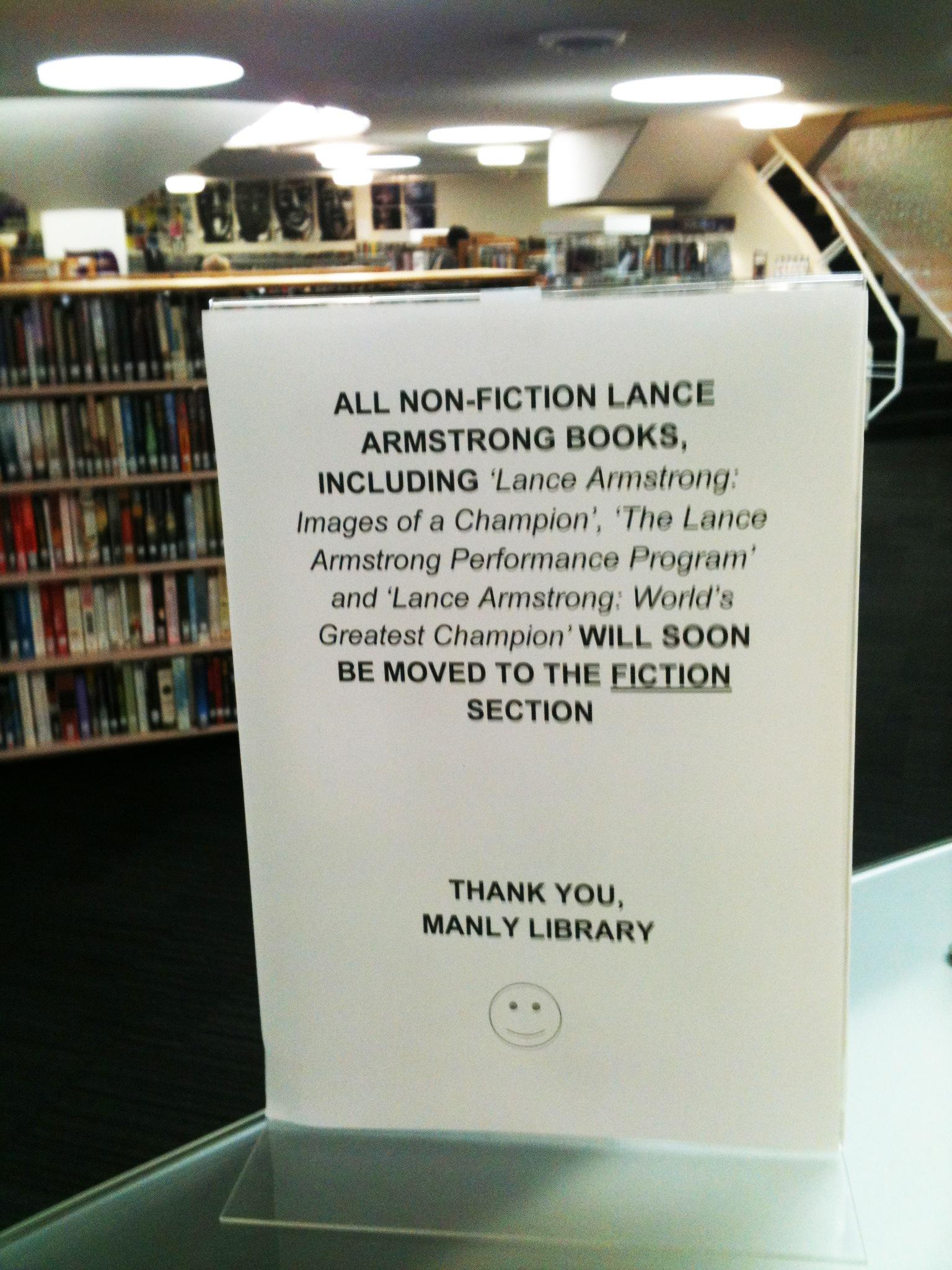
SYDNEY (Reuters) - A prank note in an Australian library declaring that disgraced cyclist Lance Armstrong's books would be moved to the fiction section has gone viral on the Internet, with one commentator declaring: "Hell hath no fury like a librarian".
"All Non-Fiction Lance Armstrong Books, including 'Lance Armstrong - Images of a Champion', 'The Lance Armstrong Performance Program and 'Lance Armstrong: World's Greatest Champion,' will soon be moved to the fiction section," read the sign posted at Sydney's Manly Library on Saturday.
A photograph of the sign posted on the Internet quickly sparked heated debate over whether Armstrong's fight against cancer and motivation of people outweighed his drug cheating in a sport rife with doping.
"As a cyclist the guy's work was inspiring, his foundation do amazing work and his story was great. ... You feel embarrassed for recommending his book to people, you stare at the books on the shelf questioning if the lessons and the inspiration is honest and real," said one commentator.
Manly Library said the printed notice, which was placed in a plastic stand on a bookshelf in the library, was a prank and that an internal review was underway.
"Libraries can't arbitrarily reclassify categories of books, because that depends on the ISBN number that is issued by the National Library," a spokesman at Manly Council, which runs the library, said on Monday.


Canada’s crime novelists: making a killing

This posting is sort of a follow-up to the last one on the Murdoch Mysteries.  This is a great article on the thriving mystery writing business in Canada.
 
I am in the middle now of reading Stray Bullets by Robert Rotenberg which as been optioned for a movie.  A Louise Penny book has been made into a television movie and Linwood Barclay and David Rotenberg also have options on their books. 
 
It is great to see that Canadian mystery writing is being recognized, not only in Canada, but around the world.  It is also good for those of us who are interested in viewers' advisory that we have more great movies and television shows to recommend!
 
Published on Friday January 18, 2013
Toronto Star

 By Greg Quill Entertainment Reporter
We make so much of serious literary fiction in this country, offering lavish prizes at the end of each year for novels that add gravitas and definition to Canada’s presence in world literature, that it’s something of a surprise to learn that we’ve also managed to accumulate a disproportionately large number of writers who are proving themselves world champions in the competitive populist genre of crime and mystery fiction.
“It’s worth noting there are as many as 20 writers of crime and mystery novels in Canada who support themselves entirely on revenue from their writing,” says Toronto-based entertainment super-agent Michael Levine. His recent decision to represent crime writers — including brothers David and Robert Rotenberg, whose work has been optioned for movies and TV in the U.S. — “is a profound change in direction for me,” he adds.
A closet fan of mystery literature and high-profile agent for many of CanLit’s giants, Levine concedes “crime is where the market’s going, and it’s growing very quickly. That’s good for Canadian crime writers.”
The crime and mystery readings at the annual International Festival of Authors at Toronto’s Harbourfront Centre are by far the prestigious literary festival’s most popular and well attended component, “always sold out in advance,” Levine points out.
Publishing insiders and crime novelists themselves are at a loss to explain the sudden appeal in the last decade of Canadian crime stories, whodunits and thrillers in a market that was earlier dominated by British, American, and more recently, Scandinavian novelists.
David Rotenberg, who says he gets through his massive agenda, balancing theatrical productions, running the Professional Actor’s Lab, and writing novels, seven of them mysteries, by “sleeping less,” believes Canadians have had time to avoid mistakes other crime and mystery writers have made.
“The Brits and Scandinavians are less interested in social context than we are,” he says. “The whodunit aspect interests me less than the social and historical forces at work in a mystery story. Hamlet would be just another whodunit if you stripped it of context, and it would have nothing important to say.”
The Stieg Larsson effect, which has all but emptied the pool of formerly regionally successful crime writers in Sweden, Denmark and Norway, seems to have created a tolerance, if not an appetite, in Britain and the U.S. for more unusual procedurals, more remote locales and more enigmatic principal characters, some suggest. Others claim Canadian crime writers have simply figured out the rather arcane rules of the mystery game and have finally learned to adapt to the demands of the international crime literature marketplace.
There are lots of reasons Canadian authors seem to have emerged as a force in the mystery book world, and little consensus, but there’s no denying it’s a formidable gathering whose names are familiar in parts of the world where many CanLit icons are barely known: Linwood Barclay, Louise Penny, Giles Blunt, Peter Robinson, Andrew Pyper, Maureen Jennings, Alan Bradley, William Deverell, David Rotenberg, Robert Rotenberg, D.J. (Dorothy) McIntosh, Tim Wynne-Jones, Gail Bowen, Joy Fielding, Mike Knowles, Howard Shrier, James W. Nichol, C.B. Forrest, among others.
“It’s a long list now, and the world is paying attention because this is writing of the highest standard,” says Penny, a prolific novelist, a consistent best seller and something of a heroine among Canadian crime writers for having set her popular series — featuring Chief Inspector Armand Gamache of the Sûreté du Québec — in the Eastern Townships, where she lives.
When Penny abandoned her 18-year career as a host and journalist on CBC Radio in order to write full time, she says, “It was excruciatingly difficult to find an agent or a publisher in Canada or elsewhere interested in a procedural with a Canadian setting.” Less than a decade later, with eight novels — all critical successes and best sellers — under her belt, “it’s almost a given that a well written mystery set in Canada with a strong central character, a page-turning plot and series potential” will find a home, she adds.
While Penny has resisted — until recently — offers to transfer her Gamache mysteries to TV or the big screen (the series is now in development for CBC under the auspices of Toronto’s PDM Entertainment, which gave her executive producer status and guarantees the integrity of her creation), TV and movie adaptations do add to a novelist’s cachet, and to the profile of the locales in which they’re set.
“But I wouldn’t bank too much on the value of the Canadian setting,” says Barclay, who was born in the U.S. but grew up in Canada. He’s considering embarking on a main character crime series after several stand-alone best sellers that have translated into more than 30 languages.
“It’s the writer’s sensibilities that make a book Canadian, if that’s what you’re looking for.
“Outside Canada people don’t care if a novel is Canadian or not, unless they’re looking for villains who are more polite than usual,” he chuckles.
Canadian crime writers, as well as the reputation of Canadian crime literature in general, seem to have benefited greatly from the added bonus TV and movies offer, a life beyond the printed page.
More than one writer interviewed for this story credit the startling international success in the past six years of the Victorian-era, set-in-Toronto TV series based on Toronto-based British expat Maureen Jennings’ The Murdoch Mysteries with having turned attention our way.
“The TV show built slowly, but it has been extremely important to the success of the books,” says Jennings, who has just published Beware This Boy, the second volume in her The Season of Darkness Trilogy, a series of Foyle’s War-type procedurals set in the British Midlands circa 1940.
“Sales have increased exponentially since the TV series found an audience (in the U.S., Britain and Europe).”
Jennings also co-created the hit Global-TV series The Bomb Girls, about a group of Canadian women working in a munitions factory during World War II.
Almost every writer with a successful crime series on the go, or a best-selling novel, has a TV or movie deal in the works. Barclay’s recent stand-alone thriller Trust Your Eyes has been optioned for a Hollywood movie, as well as two previous best sellers, No Time for Goodbye and Fear the Worst. So has Toronto writer Andrew Pyper’s soon-to-be published The Demonologist, under the auspices of Oscar-winning producer/director Robert Zemeckis (Back to the Future, Forrest Gump).
Toronto-based Brit expat Robinson’s Yorkshire policiers have been adapted for British TV as DCI Banks, which enjoys international ratings success.
Actor/theatre director/teacher David Rotenberg’s epic historical novel Shanghai and his The Junction Chronicles thrillers — The Placebo Effect and A Murder of Crows, the latter due out in March — have been optioned for U.S. movie treatments. His criminal lawyer brother Robert’s third crime novel, Stray Bullets, is in development by Canadian production company, Shaftesbury Films.
And Toronto crime novelist Giles Blunt is adapting his own hit John Cardinal mysteries, set around North Bay, Ont., where the author grew up, for a CTV series.
“Movies and TV can be a huge factor in the promotion and sales of novels — the money’s not big, and for someone like (best-selling American thriller novelist) James Patterson, it’s small change,” says Blunt, who admits he enjoys writing scripts so much that it may become his new vocation.
“But I suspect there’s a beneficial cross-over effect, especially inside the book trade.”
Robinson, whose Inspector Banks had worked his way deep into crime lit culture before Stephen Tompkinson was cast in the TV adaptation, hasn’t noticed much of a sales boost since the show started airing.
“But I think that’s because everyone who might be interested already had the books,” he said. “It helped in other ways. I got to hang out on the set and take part in the process, which I enjoyed immensely. I was impressed that all this activity was going on because I wrote a few books. I look at the TV show as a free advert.”
The book trade is far more sanguine about the prospects of TV and movie tie-ins. Mysteries sell, they always have, but since the three-part Girl with the Dragon Tattoo juggernaut a couple of years ago, the genre has kicked up the crime books business, says Sarah MacLachlan, publisher at Toronto-based House of Anansi Press, which started its own mystery imprint, Spiderline, in Larsson’s wake.
“We see better manuscripts coming in, and all the books we’ve taken on are doing very well. We’ve been selling the rights to our direct signings all over the world, and we’re particularly interested in stories that can be optioned for movies or TV.”
Publishers of crime novels are on the lookout for good story lines “and a strong lead character with the potential to grow through a series, someone readers can engage with or commit themselves to.
“The object is to get a series up and running with a devoted readership, and writers who are committed to produce a book every 9 or 12 months,” MacLachlan added.
“They should be prepared to do all that’s necessary for outreach, via social media, the Internet and conventional promotion.”
Toronto novelist, screenwriter and former Star movie critic Ron Base knows exactly what MacLachlan is talking about. He has been working on those principles for a couple of years now, writing and marketing his series of Florida-based Sanibel Sunset Detective crime novels. What sets Base apart is that he’s doing it all himself, including the publishing part.
Like so many musicians and songwriters who’ve learned in the past decade to use inexpensive digital tools and the Internet to record, sell and promote their work, Base decided to learn the ins and outs of self-publishing after his brother, an accountant who lives on Sanibel Island off Florida’s coast, suggested he write a series of locally set crime yarns to sell to island visitors during the summer — about 500,000 captive vacationers looking for the perfect beach read.
Three books into the set — the latest, Another Sanibel Sunset Detective, will be launched Jan. 28 at the P.J. O'Brien Irish Pub downtown — Base is almost living off his earnings as a writer-publisher and says he’s “blissfully unencumbered by middle men.”
He has become a local celebrity around Sanibel, and enjoys the company of his fans. He’s also something of an expert on what makes a good crime novel, and how to sell his wares via his web site, Facebook, networking and self-booked signings at pubs and bookstores in Toronto and Florida. He’s assisted by a small coterie of professional editor friends and eager readers willing to promote his work.
“Give people a reason to turn the next page and a lead character they can identify with, someone who’s flawed, like we all are, but who’s essentially a good person and likeable,” Base says, echoing almost to a word what a dozen other writers interviewed for this story had to say about the secrets of crafting a good modern mystery novel.
Adds Robert Rotenberg, who confesses his career as a criminal lawyer informs all the stories he writes: “Keep the chapters short and a good supply of unexpected plot twists. Then tie all the pieces together at the last moment.
“Unlike real life, a good crime novel has to have resolution — not necessarily happy, but one that answers all the questions you’ve thrown out there, and re-establishes some sense of moral order.”